• 27/07/2004

    Informe n.º 1 – II Encontro Continental dos Povos e Nacionalidades Indígenas das Américas

    “INTI NAPAI” – O RITUAL DE SAUDAÇÃO AO SOL E ACENDER DO JOGO


    Na abertura, hoje, do II Encontro Continental dos Povos Indígenas das Américas, em Quito, no Equador, o Sol foi saudado e reverenciado com muita emoção por mais de uma centena de representantes dos povos indígenas das Américas. Quem presidiu a cerimônia foi o mestre Pilatunha Lincango, do povo Kitukar, originário da região onde hoje está Quito.
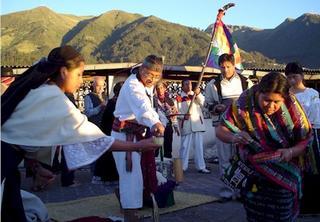

    A cerimônia milenar desse povo é extremamente rica em simbologia e expressões rituais. Um grande sol feito de frutas regionais foi sendo tecido no terraço do colégio das Irmãs Lauritas, onde está ocorrendo o Encontro. Ainda era noite, e no céu as estrelas  brilhavam, enquanto mãos, mentes e corações de indígenas de diversos povos iam preparando o cenário.


    Quando o sol surgiu, o ritual já estava se realizando. Um casal de representantes  indígenas de cada país – Colômbia, Venezuela, Peru, Equador, Bolívia, Guatemala, Brasil, México, Paraguai e Honduras – estava em círculo ao redor do sol de frutas e ramos tecidos sobre a terra cheia de pés indígenas. Houve aspersões com perfumes e bebidas indígenas, seguidas do ritual de saudação ao sol.


    Todos se sintonizaram com a mãe-terra (pachamama) num gesto de agradecimento, louvor e pedido por todos os povos indígenas do continente, espalhados do nascer ao pôr-do-sol, do Norte ao Sul das Américas. Foram abençoados os frutos da terra, e o punhado de terra trazido pelos representantes dos diversos países.


    Foram saudadas montanhas de rara beleza que envolvem a cidade de Quito e de maneira especial o Wawa  Pichincha, monte sagrado e fonte da vida do povo Kitukar.


    Do Brasil, estão presentes representantes dos povos Makuxi e Wapichana (RR), Pataxó (BA), Tapeba (CE), Sateré-Mawé (AM), Bakairi (MT) e Manchineri (AC) e de seus aliados do Cimi, Diocese de Roraima, dentre outros.


    Estão sendo esperados mais de 600 indígenas de quase todos os países do continente e de representantes de vários países da Europa, como Espanha, Itália e França. 


    As diversas delegações estão sendo recebidas com muito entusiasmo, com músicas e saudações.


    Nesta manhã ocorreu a abertura do encontro e cinco conferências sobre: Territórios, Autonomia e Livre Determinação – por Sebastião Manchineri, presidente da Coica; Diversidade e Pluralidade – por Luis Macas da Universidade Indígena – Equador; Direitos dos Povos, Nacionalidades e Movimentos Sociais dentro do Fórum Social Mundial – FSM, Por Nicia Maldonado de CONIVE – Venezuela; Militarização, por Forge Frederick (CICA); As Mulheres e a construção do Estado Plurinacional – por Vicenta Chuma (PIA).


    O II Encontro terminará no próximo domingo (25). 

    Quito, Equador, 23 de julho de 2004.

    Read More
  • 23/07/2004

    Governo Lula – 18 meses: falta compromisso com os povos indígenas

    O Cimi – Conselho Indigenista Missionário – Regional Sul – tem acompanhado com muita preocupação as decisões relativas à política indigenista do presidente Luiz Inácio Lula da Silva, neste um ano e meio de governo.


    O Cimi, como a maioria das entidades indigenistas, organizações indígenas e a imensa maioria da população brasileira, acolheu com entusiasmo, paciência, esperança e otimismo o governo do presidente Lula. Todos acreditávamos que novos caminhos poderiam ser trilhados na construção de um Brasil novo. Nós do Cimi Regional Sul entendemos que as mudanças seriam lentas, que não se dariam em um ano e meio de governo, em função das estruturas político-econômicas perversas cristalizadas há séculos em nosso país. Entendemos também que tais mudanças somente poderiam dar-se a partir de um processo de discussão, formulação e reflexão dentro do Governo Federal, garantindo a participação ampla da sociedade, das entidades, dos movimentos sociais, das Igrejas, dos partidos políticos, dos governos estaduais e municipais.


    Nossa avaliação é de que o governo Lula não assumiu sua responsabilidade histórica e legítima de conclamar a sociedade brasileira para ajudá-lo a construir novos caminhos, tendo em vista a justiça social, a paz no campo, o pagamento de salários mais justos, a redução de impostos, a estruturação de programas de geração de emprego e de renda, a reforma agrária, a demarcação das terras indígenas e a formulação e estruturação de novas políticas públicas, dentre elas a indigenista. Pelo contrário, todos os indicativos, até o momento, apontam para uma mudança de rumo no governo e não na estrutura da nação brasileira. Não vemos o governo Lula como “um governo em disputa”. Se algum dia esteve, pelo que temos visto, já tomou a sua decisão. Apesar de não assumir publicamente sua posição, preferindo esconder-se atrás do demagógico e irealista slogan “Brasil: um país de todos” (sic), optou por aliar-se aos grupos econômicos e políticos que sempre estiveram na condução do país e que são, conseqüentemente, os responsáveis por grande parte dos problemas estruturais do Estado Brasileiro, a saber, a corrupção, a exclusão social, a concentração de renda e de terra, a violência no campo e na cidade e as impagáveis dívidas interna e externa que beiram um trilhão de dólares.


    No que se refere aos povos indígenas, avaliamos que o governo do presidente Lula optou por evitar conflitos com militares, fazendeiros, arrozeiros, políticos, madeireiros, mineradores e empresas geradoras de energia elétrica. O governo do presidente Lula, no entender do Cimi Regional Sul,  rendeu-se às pressões e chantagens impostas por estes setores. Este governo, sabendo dos interesses econômicos e políticos que teria de enfrentar caso optasse por demarcar e proteger as terras e  estruturar uma política e um órgão indigenista capaz de executar ações realmente voltadas para a defesa dos direitos e interesses dos povos indígenas, acovardou-se e preferiu trilhar o caminho mais fácil, caminho da omissão e da conivência com os setores antiindígenas.


    Em conseqüência disso, o governo do presidente Lula agride diretamente os direitos indígenas adiando decisões relativas a procedimentos regularizatórios perfeitos e conclusos. Exemplos claros são os casos das Terras Indígenas  Guarani do Araça’í, Palmas e Morro dos Cavalos em Santa Catarina e da Terra Indígena Raposa Serra do Sol em Roraima. Em função de sua inércia em relação às ações indigenistas, o Governo Federal transformou-se no principal fomentador de violências conta os povos indígenas, tais como,  invasões e redução das terras, como nos casos, respectivamente, dos Pareci e Enawene-Nawê no Mato Grosso e da Terra Baú no estado do Pará, típico favorecimento governamental às grandes empresas madeireiras devastadoras do meio ambiente, e de assassinatos e estupros, como nos casos ocorridos nos últimos dias, a morte do líder Kaingang Neves Kenes Farias e o estupro a uma criança Kaingang no Rio Grande do Sul e  os assassinatos de dois adolescentes Kaiowá na área indígena de Dourados no Mato Grosso do Sul.


    No entender do Cimi Regional Sul, o Governo Federal é também o principal responsável pelas dezenas de ações judiciais movidas contra as demarcações de terras, como, entre outros casos, o da Terra Indígena Toldo Chimbangue II e La Klaño em Santa Catarina e, novamente, Raposa Serra do Sol em Roraima. Tais ações somente foram impetradas devido à excessiva morosidade da Funai, do Ministério da Justiça e da Presidência da República em resolver as referidas questões. Vale ressaltar que o Poder Judiciário, em conexão com o Poder Executivo, tem se manifestado, muito seguidamente, contra os Povos Indígenas beneficiando invasores e depredadores das suas terras.


    Ao Cimi Regional Sul, é evidente a pré-disposição antiindígena do atual governo na relação estabelecida no âmbito do Poder Legislativo. Ali o governo abre espaços para a negociação das garantias constitucionais destes povos fazendo gestão sistemática junto a  sua bancada afim de que esta se mobilize e, de forma articulada, crie Comissões Parlamentares, na Câmara dos Deputados e no Senado Federal, e apresente propostas revisionistas aos direitos indígenas, invariavelmente contrárias aos mesmos, como foram os casos dos parlamentares governistas, o deputado Lindberg Farias (PT/RJ) e o senador Delcídio Amaral (PT/MS), que costuraram macabros relatórios sugerindo e justificando emendas à Constituição Brasileira que restringem seriamente os direitos dos povos indígenas. As ameaças aos artigos 231 e 232 da nossa Carta Magna nunca foram tão constantes e tão ruidosas como nos últimos meses.


    No núcleo Poder Executivo, o governo do presidente Lula delegou aos setores militares o estudo de uma proposta de política indigenista para o país. Pode-se constatar isso com a criação de um Grupo de Trabalho, pelo Gabinete de Segurança Institucional, composto em sua grande maioria por órgãos historicamente contrários aos povos indígenas. Soma-se a isso, a continuidade do processo de sucateamento e intromissão no órgão indigenista oficial. A previsão orçamentária da Funai para o ano 2004 é menor que o orçado no governo passado para o período de 2003.


    Finalmente, a pulverização das ações indigenistas e a falta de uma articulação entre os diferentes ministérios que prestam serviços às comunidades indígenas revelam as intenções do governo em não fazer cumprir os direitos indígenas para evitar conflitos e “desgastes políticos”.


    O Cimi Regional Sul, ao concluir este balanço, quer lembrar o Sr. Presidente Luiz Inácio Lula da Silva, que Vossa Excelência e seus ministros serão julgados por seus atos, omissões e falta de respeito aos compromissos assumidos. O que se esperava desse governo era a busca de mais justiça social, construída aos poucos, mas com passos decididos. O retrocesso e a traição dessa esperança será cobrada, com força e coragem, pelos brasileiros que confiaram em propostas e promessas tratadas hoje pelo governo como página virada na história. Parece-nos ver aquele que pediu-nos para esquecermos tudo o que havia escrito, naquele que, por suas opções, nos faz esquecer tudo o que sempre falou.


    Chapecó-SC, 22 de julho de 2004.


    Conselho Indigenista Missionário – Regional Sul


    Read More
  • 22/07/2004

    Informe n.º 623


    II ENCONTRO CONTINENTAL DOS POVOS E NACIONALIDADES INDÍGENAS DAS AMÉRICAS


    “INTI NAPAI” – O RITUAL DE SAUDAÇÃO AO SOL E ACENDER DO JOGO


    Na abertura, hoje, do II Encontro Continental dos Povos Indígenas das Américas, em Quito, no Equador, o Sol foi saudado e reverenciado com muita emoção por mais de uma centena de representantes dos povos indígenas das Américas. Quem presidiu a cerimônia foi o mestre Pilatunha Lincango, do povo Kitukar, originário da região onde hoje está Quito.


    A cerimônia milenar desse povo é extremamente rica em simbologia e expressões rituais. Um grande sol feito de frutas regionais foi sendo tecido no terraço do colégio das Irmãs Lauritas, onde está ocorrendo o Encontro. Ainda era noite, e no céu as estrelas  brilhavam, enquanto mãos, mentes e corações de indígenas de diversos povos iam preparando o cenário.


    Quando o sol surgiu, o ritual já estava se realizando. Um casal de representantes  indígenas de cada país – Colômbia, Venezuela, Peru, Equador, Bolívia, Guatemala, Brasil, México, Paraguai e Honduras – estava em círculo ao redor do sol de frutas e ramos tecidos sobre a terra cheia de pés indígenas. Houve aspersões com perfumes e bebidas indígenas, seguidas do ritual de saudação ao sol.


    Todos se sintonizaram com a mãe-terra (pachamama) num gesto de agradecimento, louvor e pedido por todos os povos indígenas do continente, espalhados do nascer ao pôr-do-sol, do Norte ao Sul das Américas. Foram abençoados os frutos da terra, e o punhado de terra trazido pelos representantes dos diversos países.


    Foram saudadas montanhas de rara beleza que envolvem a cidade de Quito e de maneira especial o Wawa  Pichincha, monte sagrado e fonte da vida do povo Kitukar.


    Do Brasil, estão presentes representantes dos povos Makuxi e Wapichana (RR), Pataxó (BA), Tapeba (CE), Sateré-Mawé (AM), Bakairi (MT) e Manchineri (AC) e de seus aliados do Cimi, Diocese de Roraima, dentre outros.


    Estão sendo esperados mais de 600 indígenas de quase todos os países do continente e de representantes de vários países da Europa, como Espanha, Itália e França. 


    As diversas delegações estão sendo recebidas com muito entusiasmo, com músicas e saudações.


    Nesta manhã ocorreu a abertura do encontro e cinco conferências sobre: Territórios, Autonomia e Livre Determinação – por Sebastião Manchineri, presidente da Coica; Diversidade e Pluralidade – por Luis Macas da Universidade Indígena – Equador; Direitos dos Povos, Nacionalidades e Movimentos Sociais dentro do Fórum Social Mundial – FSM, Por Nicia Maldonado de CONIVE – Venezuela; Militarização, por Forge Frederick (CICA); As Mulheres e a construção do Estado Plurinacional – por Vicenta Chuma (PIA).


    O II Encontro terminará no próximo domingo (25). 


    Brasília, 22 de julho 2004.


    Cimi – Conselho Indigenista Missionário

    Read More
  • 21/07/2004

    CIMI INFO-BRIEF 622

    2. Kontinentaltreffen der indigenen Völker Amerikas


    Vom 21. ­ 25.07.2004 findet in Quito (Ecuador) das zweite kontinentale Treffen der Indigenen Völker von Amerika statt. Brasilien entsendet sechs indigene Vertreter von der Koordination der Indigenen Organisationen vom Brasilianischen Amazonien (COIAB), von der Artikulation der Indigenen Völker vom Nordosten, von Minas Gerais und Espírito Santo (APOINME) und vom Indianerrat von Roraima (CIR). Das Treffen steht zum Abschluss der Dekade der Indigenen Völker, die von den Vereinten Nationen 1994 ausgerufen wurde.


    Nach diesem Treffen beginnt am 25.07.2004 das 1. Sozialforum der Amerikas, das folgende Schwerpunkte behandelt: kulturelle Reichtümer und Erfahrungen der Völker der einzelnen Länder teilen; Alternativen auf der Grundlage der Visionen der Völker entwickeln; Solidarität und gemeinsame Aktionen zur Verteidigung der Rechte und Entwicklung der indigenen Völker; Stärkung der indigenen Beteiligung beim Weltsozialforum; Bündnisse mit anderen sozialen Sektoren auf dem Kontinent.


    Fünf Tage lang werden die Indios des Kontinents bei Konferenzen, Arbeitsgruppen und Diskussionen mitarbeiten. Geplante Themen sind: Land, natürliche Ressourcen, Autonomie und Selbstbestimmung, Vielfalt und Pluralität, indigenes Wissen und intellektueller Besitz, indigene Organisationen und multilaterale Institutionen, Nationalitäten und indigene Völker, soziale Bewegungen und Weltsozialforum, indigene Frauen, politische Mitbestimmung und alternative Regierungsformen, Militarisierung. Daneben gibt es täglich einen zeremoniellen Akt, eine interkulturelle Nacht und einen Marsch durch die Hauptstrassen von Quito.


    Exekutivsekretär des Cimi, Éden Magalhães, erwartet sich durch seine Teilnahme die Einbindung des Cimi in diesem Prozess auf der Suche nach  Alternativen angesichts des hegemonialen Modells des Neoliberalismus.


    Der CIMI-Mitarbeiter Egon Heck hofft auf eine Vertiefung der Fragen des ersten kontinentalen Treffens sowie auf Strategien für das nächste Weltsozialforum und weitere internationale Versammlungen. “Dieses zweite Treffen bezeugt die Kontinuität vom Prozess der Gestaltung von Alternativen für den Einsatz der indigenen Völker auf dem amerikanischen Kontinent. Allerdings sind noch mehr Anstrengungen erforderlich”.


    Die indigenen Völker sind von den Regierungen in ihren Ländern enttäuscht, etwa mit der Regierung Lula in Brasilien, sodass “diese Begegnungen eine Stärkung für die indigenen Bewegungen sein könnten, damit ihre Anliegen endlich berücksichtigt werden”, so Heck abschliessend.


    Osmar Pataxó von der APOINME und der Front des Widerstands und des Einsatzes der Pataxó hat für Quito grosse Hoffnungen. Der Austausch von Erfahrungen, Bündnisse mit Völkern von anderen Ländern und Solidarität für sein Volk sind für ihn am wichtigsten. “Der Einsatz der indigenen Völker darf sich nicht  nur auf das eigene Land beschränken. Gemeinsam mit den Völkern anderer Länder sind wir stärker. Wir, die Pataxó vom Süden Bahias, drängen auf die Demarkierung unseres traditionellen Gebietes Monte Pascoal. Bei diesem Treffen können wir unseren Einsatz und die Bedrohungen, die wir von den Pistoleiros der Fazendeiros erleiden, international bekannt machen”.


    Osmar wird sein Volk erstmals ausserhalb von Brasilien vertreten. “Die Teilnahme von Völkern aus anderen Ländern wird eine grosse Bereicherung für uns sein. Ich bin mir dieser Verantwortung bewusst und sehr bewegt, dass ich unseren Einsatz vor die Weltöffentlichkeit bringen kann”.


    Das 1. Treffen der Indigenen Völker Amerikas fand im März 2001 in Ottawa (Kanada) statt.


    Indigene Völker und soziale Organisationen von Mato Grosso do Sul gegen Vorschlag des Senators


    Rund 700 Vertreter der Völker Atikum, Guarani-Kaiowá, Terena, Kadiwéu, Kinikinawá, Ofaié und Guató waren am 02.07.2004 in Campo Grande beim Plenum der sozialen Bewegungen von Mato Grosso du Sul, die zur Verteidigung der indigenen Rechte und gegen den Bericht des Senators Delcídio Amaral (PT/MS) mobilisieren.


    Die indigenen Vertreter, 25 Organisationen, Staatsanwälte der Republik von Campo Grande und Dourados, Vertreter von Regierungsorganen und der Abgeordnete des Bundesstaates, Pedro Kemp, diskutierten den Bericht des Senators, den der Senat am 08.06.2004 angenommen hat. Gemäss diesem Bericht werden Gebiete in Grenzregionen und Gebiete mit Invasoren nicht demarkiert. Auch soll die Entscheidung über die Demarkierung von indigenen Gebieten dem Rat für Nationale Verteidigung und dem Bundessenat übertragen werden.


    Die Teilnehmer kritisierten und lehnten die Vorschläge des Berichts ab. Die Untersagung der Demarkierung von Gebieten sei ein Angriff auf die historischen Rechte der indigenen Völker, eine Missachtung der Bundesverfassung und ein Nährboden für die Gewalt gegen die indigenen Völker.


    Das Plenum übergab ein Dokument mit Vorschlägen an den Senator. Laut Bundesverfassung seien die indigenen Rechte garantiert und der Bund und der  Bundesstaat Mato Grosso do Sul tragen die Verantwortung für die Übertragung von indigenen Gebieten an Dritte. Senator Delcídio versprach, die Vorschläge  dem Präsidenten zu übermitteln und sie als Gesetzesprojekt für den Senat auszuarbeiten.


    Beim Plenum am 23.06.2004 wurde der Bericht des Senators bereits abgelehnt und als Begründung 13 Vorschläge aufgeführt, darunter die Beibehaltung und Anwendung der Artikel 231 und 232 der Verfassung sowie die sofortige Ausführung von Artikel 67 der Akte der Verfassungsübergangsbestimmung.


    Die indigene Bewegung und die sozialen Organisationen werden weiterhin für die Rechte der indigenen Völker und die Demarkierung der indigenen Gebiete im Bundesstaat und national mobilisieren.


    Brasília, 15. Juli 2004
    Cimi ­ Indianermissionsrat

    Read More
  • 21/07/2004

    Newsletter n. 622

    2nd CONTINENTAL MEETING OF INDIGENOUS PEOPLES OF THE AMERICAS


    The 2nd Continental Meeting of Indigenous Peoples of the Americas will be held on July 21-25 in Quito, Ecuador. Six indigenous leaders from Brazil representing the Coordinating Board of Indigenous Organizations of the Brazilian Amazon Region (Coiab), the Association of Indigenous Peoples of the Northeast, Minas Gerais and Espírito Santo (Apoinme), and the Indigenous Council of Roraima (CIR) will attend the meeting, which will be one of the events marking the end of the Decade of the World’s Indigenous Peoples, as declared by the United Nations in 1994. 


    The meeting precedes the 1st Social Forum of the Americas, which will begin on the 25th and has the following objectives: sharing the cultural wealth, struggle, and realities of the different indigenous peoples of each country; developing alternative proposals based on the vision that these peoples have of the world; fostering closer bonds of solidarity and joint actions to defend the rights and development of indigenous peoples; and establishing permanent mechanisms amongst the peoples to strengthen their participation in the World Social Forum and alliances with other social sectors on the continent.


    During the five days of the meeting, indigenous people from different parts of the American continent will take part in conferences, round tables, and plenary sessions in which the following topics will be discussed: lands, territories and natural resources; autonomy and free self-determination; diversity and plurality; indigenous knowledge and intellectual property; indigenous rights and multilateral organizations; nationalities and indigenous peoples; social movements and the World Social Forum; indigenous women; political participation and alternative governments; and militarization. A ceremonial act will also be held every day, as well as an intercultural night and a march through the main streets of Quito.


    According to Cimi’s executive secretary, Éden Magalhães, who will attend the meeting, the entity is expected to enhance its contribution to this worldwide search for alternatives to the hegemonic neo-liberal model.


    Egon Heck, a Cimi missionary who will also attend the meeting in Quito, believes that the participants will engage in deeper discussions about the issues addressed during the first continental meeting and that, above all, strategies will be defined to continue the discussions during the next World Social Forum and other international meetings. “This second meeting shows that the process of building alternatives based on the struggle and experiences of indigenous peoples has advanced, but we have to advance further.”  


    Egon highlighted that because of the frustration experienced by indigenous peoples with the governments of their countries, as with the Lula administration in Brazil, “these large meetings inspire and strengthen local movements in the different countries and bring hope to them when governments try to defeat the aspirations and advances of the indigenous movement,” he concluded.     


    Osmar Pataxó, who will represent Apoinme and the Pataxó Resistance and Struggle Front, has high expectations in relation to this meeting. The exchange of experiences, the joining of forces with peoples from other countries and the possibility of disseminating the struggle of the Pataxó People are, according to this indigenous leader, the most important benefits afforded by the meeting.  “The struggle of indigenous peoples should not be just a domestic struggle. We must joint forces with peoples from other countries in order to become stronger. We, the Pataxó people from the south region of Bahia, are fighting for the demarcation of the Pascoal Mount land, which is our traditional territory, and this meeting will allow us to disseminate our struggle internationally and to report the threats we have been receiving from gunmen hired by farmers in our region.”


    This is the first time that Osmar will be leaving Brazil to represent his people in another country, a task he is taking very seriously and which touches him deeply. “Indigenous peoples from other countries will be attending the meeting, and this will enrich our people very much. I have the huge responsibility of representing the Pataxó People out of Brazil and I am thrilled with this opportunity to disseminate the struggle of the Pataxó people to the world.”


    The 1st Meeting of Indigenous Peoples of the Americas was held in Ottawa, Canada, in March 2001. 


    INDIGENOUS PEOPLES AND ORGANIZATIONS LINKED TO SOCIAL MOVEMENTS IN MATO GROSSO DO SUL REJECT PROPOSAL FROM SENATOR


    About 700 leaders from the Atikum, Guarani-Kaiowá, Terena, Kadiwéu, Kinikinawá, Ofaié and Guató peoples attended a plenary session held in Campo Grande on JuLy 2 by organizations linked to social movements of the state of Mato Grosso do Sul to further their mobilization efforts in defense of indigenous rights and against a report prepared by Senator Delcídio Amaral (Workers’ Party/state of Mato Grosso do Sul).


    The indigenous leaders, as well as representatives from 25 organizations, state attorneys of Campo Grande and Dourados, representatives of governmental agencies, and state representative Pedro Kemp, discussed the report prepared by the senator and approved by the Senate on June 8, which prohibits the demarcation of indigenous lands in border areas and of indigenous lands to which invaders have title deeds and conditions the demarcation of all indigenous lands to the prior approval of the National Defense Council and the Federal Senate.


    The participants challenged and rejected the propositions made in the report, arguing the restrictions they impose on the demarcation of indigenous lands disregard historical rights of indigenous peoples and the Federal Constitution, in addition to fostering violence against indigenous people.


    On that occasion, a document was approved and delivered to the senator with proposals for ensuring indigenous rights provided for in the Federal Constitution, and accusing the Federal Administration and the state of Mato Grosso do Sul of unduly transferring indigenous lands to third parties and issuing title deeds to them. (click here to read the full document).


    When he received the document, senator Delcídio promised to show the proposals to the President of the Republic and to turn them into a bill to be passed by the Senate. 


    Before this meeting, the participants in a plenary session held on June 23 had rejected the report of the senator and defended 13 proposals, among which a proposal to  “maintain  and apply Articles 231 and 232 and immediately enforce the provisions of Article 67 of the Transitional Constitutional Provisions.” (click here and read the document)


    Faced with this reality, indigenous movements and organizations decided to remain mobilized and to continue to defend and follow up on the rights of indigenous people and the demarcation of indigenous lands at state and national level.


    Brasília, 15 July 2004.
    Cimi – Indianist Missionary Council

    Read More
  • 21/07/2004

    Carta de Dom Erwin Krautler ao ministro da Justiça

    Exmo. Sr. Dr. Márcio Tomás Bastos


    DD. Ministro da Justiça


    Esplanada dos Ministérios


    Bloco T Ed. Sede 4º Andar


    70064-900 Brasília DF


    Altamira, 19 de julho de 2004


    Excelentíssimo Senhor Ministro,


    Os povos indígenas deste País somente têm alguma chance de sobreviver se as terras que habitam desde tempos imemoriais são demarcadas e como tais homologadas. Em relação ao povo Ugorogmo, popularmente chamado de Arara, que vive na região denominada de Cachoeira Seca nos municípios de Uruará, Altamira e Rurópolis, no Estado do Pará, o Ministério da Justiça, já em 1993 havia baixado portaria referente à demarcação de sua área.


    Finalmente, há poucas semanas, foi iniciado o trabalho de demarcação física, com base na portaria 26/MJ de 22 de janeiro de 1993. Como era de se esperar tal demarcação está causando fortes reações da parte de moradores não-indígenas da referida área, incitados por políticos locais, interessados em ganhar votos no pleito eleitoral municipal.


    O que me preocupa é, sem dúvida, a sobrevivência do povo Arara. Trata-se de um povo extremamente frágil, há décadas agredido por todo o tipo de invasores. Só a garantia do habitat tradicional e o respeito a seu território evitará o desaparecimento de mais um povo da Amazônia. O Brasil não se pode dar o luxo de assistir inerte à tragédia da morte física de mais um povo indígena que já habitou estas plagas bem antes que o Brasil como País existisse. Não há mais por que discutir limites. Esta fase dos tramites legais já passou. Importa agora agilizar o procedimento demarcatório sem tergiversação ou afagos a políticos locais de índole anti-indígena.


    Entretanto a situação dos colonos ilegalmente assentados pelo INCRA em área indígena também me causa preocupação. Obviamente não podem ser tratados como usurpadores criminosos de terras alheias. O INCRA comprometeu-se a reassentar estas famílias em áreas fora da terra indígena, mas reassentar não significa consignar apenas um outro lote rural aos agricultores e suas famílias. Tem que ser levado em conta todo o patrimônio que estas famílias adquiriram com o trabalho de suas mãos e o suor de sua testa desde o ano em que foram assentadas. As benfeitorias terão que ser indenizadas e ressarcidos todos os prejuízos sofridos, advindos do assentamento ilegal realizado pelo INCRA. Os colonos não se opõem a um reassentamento, mas estão muito apreensivos quanto às condições de vida numa nova terra, onde devem recomeçar tudo. O povo tem medo de indenizações e ressarcimentos apenas simbólicos e, na realidade, ser colocado no olho da rua, entregue à própria sorte. Além de uma nova terra, os colonos precisam de não parcos recursos para poderem reiniciar suas atividades agrícolas. Não são esmolas que pedem ao INCRA e através dele ao Governo, eles querem ser respeitados em seus direitos. Também as outras famílias que chegaram depois e estão em situação irregular devem ser assentadas após levantamento realizado pelo INCRA. Caso contrário a legião dos sem-terra será engrossada por mais um contingente de brasileiros sem eira nem beira.


    Sou o bispo desta região e V. Excia. me conhece. Conto com o empenho de V. Excia. numa causa tão nobre e de vital importância tanto para o povo Arara como para os agricultores e suas famílias.


    Cordialmente,


    Erwin Krautler

    Bispo do Xingu

    Read More
  • 20/07/2004

    Ministro da Justiça e Presidente da Funai comemoram redução da T.I. Baú


    Como não bastasse ter no ano passado determinado a redução dos limites da T.I. Baú (PA), cedendo às pressões dos invasores, o Ministro da Justiça Márcio Thomaz Bastos participou, no Pará, das comemorações pela redução da Terra Indígena. O evento, divulgado na noite de 15 de julho, em reportagem do Jornal Nacional, da Rede Globo, contou também com a participação do antropólogo Mércio Gomes, presidente da Fundação Nacional do Índio – Funai.


    Em outubro do ano passado o Ministro já havia causado surpresa e indignação ao ceder às intimidações dos invasores da área, que durante dias haviam submetido a comunidade Kayapó e os técnicos da Funai que realizavam os trabalhos de demarcação da terra indígena,  a um clima de terror, onde não faltaram ameaças e até mesmo supressão de seus direitos constitucionais de ir e vir, fatos esses amplamente divulgados pela imprensa: “Fazendeiros tentam barrar demarcação no Pará” (O Estado de São Paulo – SP, 08.09.03, p. A-7);  Demarcação de terra gera tensão. Rodovia Santarém-Cuiabá foi fechada, comércio da cidade de Novo Progresso parou e homens armados ameaçaram retirar à bala técnicos da Funai.” (Jornal do Commércio, Recife/PE, 18.09.03, pág. Brasil – 06); “Protesto armado contra índios” (Estado de Minas, BH/MG, pág. Brasil – 11); “Tensão no Pará – Confronto Iminente em terra Indígena” (Correio Braziliense, Brasília – DF, 18.09.03).


    A chamada “Terra do Meio”, região onde se localiza a T.I. Baú, vem sendo objeto de várias denúncias como pólo de exploração madeireira e pecuária, inclusive para exportação, sustentado às custas de trabalho escravo. Segundo a Folha On Line de ontem, 19 de julho, na última quinta-feira 15, cerca de 70 trabalhadores haviam sido resgatados de uma fazenda na região, que estava sendo desmatada para fins de formação de pastagem e criação de gado.


    Relatório do Greenpeace intitulado “Pará, Estado de Conflito” informa com relação a “Terra do Meio” que “madeireiros e fazendeiros ilegais se tornaram a única força econômica significativa na região e muitos habitantes locais se tornaram dependentes dessas indústrias, lutando junto com eles contra o governo”. As pressões pela redução da T.I. Baú vieram, exatamente, neste contexto de violação de direitos humanos, de ilegalidade e de depredação ambiental.


    Sucumbindo às pressões o Ministro revogou a Portaria Declaratória n.° 645/91, substituindo-a pela de n.° 1.487, de 8.10.2003, na qual exclui dos limites da terra a ser demarcada 306 mil e 540 ha, cuja ocupação é comprovadamente tradicional indígena.


    O precedente negativo representado pela medida logo gerou, nos jornais, manchetes do tipo: “Ficou mais fácil: Ministério da Justiça reduz área indígena no Pará” (Rondôniaagora.com – Porto Velho, 14.10.03)  Terra indígena é reduzida no Pará e decisão é exemplo para Roraima” (Folha de Boa Vista – RR, 24.11.03, p. 3); ”Outra área pode ser reduzida no PA” (Folha de São Paulo, SP – 17.10.03: “Depois de reduzir a Terra Indígena Baú, o Governo Federal vai receber pedido de fazendeiros e parlamentares petistas para  rever os limites de outra área indígena, a Cachoeira Seca, em Uruará – PA…”).


    A situação levou o Ministério Público Federal a ajuizar, perante a Seção Judiciária Federal em Brasília – DF, a Ação Civil Pública n.° 2004.34.00.011776-6 contra a União e a Funai, apontando a ilegalidade da redução da terra indígena e a obrigação de que seja demarcada conforme os limites tradicionalmente ocupados, como manda a Constituição Federal.


    Agora, o Ministro da Justiça e o presidente do órgão indigenista oficial viajaram ao local e participaram, pessoalmente, dos festejos pela redução da T.I.  Neste mesmo dia o “site” da Funai na Internet anunciou: “Brasil mostra ao mundo sua política indigenista”.


    Conforme o “site” o presidente da Funai deverá estar participando, nestes dias 18 a 23, em Genebra, Suíça, da 22ª Sessão do Grupo de Trabalho sobre Populações Indígenas, que tem como temática “Povos indígenas e a resolução de conflitos”.
    Segue a matéria dizendo que “a política indigenista brasileira está chamando a atenção de outros países”, e que, segundo Mércio Gomes, “é o momento de inserirmos com mais ênfase a política indigenista brasileira no cenário internacional”.


    A julgar pela disposição do Ministro e do Presidente da Funai em festejar, na aldeia Kayapó, a redução da T.I. Baú, não é difícil concluir que a política indigenista brasileira à qual o presidente do órgão tenha se referido, e que certamente está levando como modelo para “o cenário internacional” seja uma pretensa “solução de conflitos” via redução de direitos indígenas, via redução de terras indígenas, através da legitimação de ameaças e chantagens, através da violação da Constituição Federal.


    O Conselho Indigenista Missionário vem externar sua indignação com mais este episódio deplorável, que exemplifica a triste opção do governo Lula por uma política indigenista calcada no progressivo esmagamento dos direitos dos povos indígenas em benefício de uma relação utilitária com interesses políticos e econômicos, que além do mais sempre se locupletaram imoral e ilicitamente das terras indígenas e de seus recursos naturais. Um mau exemplo a ser mostrado ao mundo.


    Brasília – DF,  20 de julho de 2004.


    Cimi  – Conselho Indigenista Missionário

    Read More
  • 20/07/2004

    Newsletter n. 621

    STF AND STJ UPHOLD PRELIMINARY ORDER WHICH REDUCES THE SIZE OF THE RAPOSA/SERRA DO SOL INDIGENOUS LAND


    A new chapter has began in the struggle for the official confirmation of the bounds of the Raposa/Serra do Sol indigenous land. Like the associate judge of the Supreme Court (STF) Ellen Gracie, who last Friday rejected a request for suspending a preliminary order reducing the size of the Raposa/Serra do Sol indigenous land filed by attorney general Cláudio Fonteles, the chief justice of the Higher Court of Justice (STJ), Edson Vidigal, followed suit on Tuesday (the 6th) and rejected a request filed by the Federal Attorney’s Office (AGU).


    Both the AGU and the Federal Prosecution Service requested the suspension of the decision of justice Selene Maria de Almeida of the federal court of appeals of the 1ª Region, which upheld and expanded the scope of a preliminary order issued by the Federal Judge of Roraima, Helder Girão Barreto, partially suspending the effects of Administrative Ruling 820/98 issued by the ministry of Justice. 


    When analyzing the interlocutory appeals filed by the Federal Prosecution Service and the Maturuca indigenous community against the preliminary order issued by Barreto, judge Selene Maria went beyond her regular  duties and changed the decision of the judge and expanded the effects of the preliminary order by excluding a border strip from the area, which decision will remain effective until the National Defense Council is summoned to issue an opinion on the use of areas located along the border with Guyana and Venezuela and of an environmental conservation unit called National Roraima Mount Park. On the occasion of the STF request, the general attorney said that “both decisions are clearly unconstitutional in many regards.”


    According to Cimi, the upholding of these preliminary decisions favors the interests of groups which oppose indigenous rights and of certain economic and political groups. However, these decisions are obstacles to be eliminated, since the right of indigenous people to lands traditionally occupied by them is unquestionable. 


    Cimi will continue to support the struggle of the indigenous people living in the Raposa/Serra do Sol land and to reaffirm that this land has been traditionally occupied by about 15,000 indigenous people belonging to five ethnic groups, which is a fact already acknowledged by the government when it signed and published Administrative Ruling 820/98, which ensures the possession of 1.7 million hectares to the indigenous people living in them.


    SOCIAL MOVEMENTS VISIT THE RAPOSA/SERRA DO SOL LAND IN SUPPORT OF INDIGENOUS PEOPLE


    A group made up of 60 leaders of union, social, and environmental movements representing 21 civil society organizations of the state of Roraima visited this morning the Jauari village, which was recently built by indigenous people, to defend the official confirmation of the bounds of the Raposa/Serra do Sol indigenous land and prevent the expansion of rice crops in the area.


    The Movement called “We Exist” has been organizing visits of ordinary citizens and representatives of civil society organizations to the area as a means to show to indigenous people and the population of Roraima at large that local social movements are concerned about how the bounds of the Raposa/Serra do Sol indigenous land will be actually confirmed and about the environmental damages caused by environmental degradation and the excessive use of pesticides in rice crops.


    The delegation is made up of representatives of 17 unions linked to the Single Workers’ Union (CUT/state of Roraima) and to associations linked to the Amazonian Working Group (GTA/state of Roraima) It also includes leaders of  the Talher Estadual (Zero Hunger Program), of cooperatives of rural workers, and of the Diocese of Roraima.


    In a note, the organizations ask “until when will economic interests prevail over the right to life, over human rights, and over the law?” (click here and to read the full document).  In addition to expressing their support to the official confirmation of the bounds of the land as a continuous area, the organizations call on the population of Roraima “not to accept further invitations to confrontations and to say no to the impunity which has been jeopardizing the regional development of the state and a future of peace and justice”.


    Brasília, 8 July 2004


    Cimi – Indianist Missionary Council

    Read More
  • 20/07/2004

    Newsletter n. 620

    COMMUNITIES OF THE RAPOSA/SERRA DO SOL LAND OCCUPY THE BANKS OF A RIVER TO PREVENT ENVIRONMENTAL DEGRADATION CAUSED BY RICE FARMERS


    Tired of waiting for a positived decision of the federal administration in relation to the official confirmation of the bounds of the Raposa/Serra do Sol indigenous land and concerned about the environmental degradation caused by rice farmers, the communities of the Raposa, Serras, Baixo Cotingo and Surumu lands decided to occupy the banks of the Jauari river in an area located at 180 kilometers from Boa Vista.


    They began to occupy the area yesterday (the 30th) as a means to prevent rice farmers from continuing to cause environmental degradation in indigenous lands, a situation that has been repeatedly reported to the competent agencies but in relation to which the authorities, namely, Funai, the Public Prosecution Service, the Federal Police, and Ibama have done nothing.


    Over 300 indigenous people from villages located in the Raposa/Serra do Sol land affected by the pollution of rivers caused by the excessive use of pesticides in irrigated rice crops are taking part in the action.


    The largest rice farmer in the indigenous land, Paulo César Quartieiro, went to the area occupied by the indigenous people on the 29th to intimidate indigenous leaders when they were beginning to build houses/shelters at night on the banks of the river. After failing to intimidate them, he reported the situation to the Federal Police.


    Despite all the positive expectations in relation to the official confirmation of the bounds of the Raposa/Serra do Sol indigenous land, the communities decided not to wait for the judgment of an appeal against a preliminary order issued by a federal court of Roraima, which was upheld by judge Selene Almeida, in order to exercise their constitutional rights.  The Federal Administration has suggested that it will confirm the bounds of the land if the preliminary order is rejected.


    The delay to confirm the bounds of the Raposa/Serra do Sol land has allowed rice crops to be expanded and has caused irreparable damages to the environment and to the physical and cultural heritage of indigenous peoples. This situation can be attributed to the lack of concrete actions on the part of the Brazilian Government to ensure the territorial rights of indigenous people.


    The Indigenous Council of Roraima will take measures to avoid the occurrence of conflicts between the communities which decided to occupy the area in question and grabbers of federal lands who destroy nature and violently attack indigenous peoples and their allies without being held accountable for their actions.


    INVADERS OF THE CACHOEIRA SECA INDIGENOUS LAND HAVE PLANS TO PREVENT ITS DEMARCATION


    Invaders of the Cachoeira Seca indigenous land, where the Arara people live in Uruará, state of Pará, have plans to prevent the demarcation of the area, which Funai began to carry out two weeks ago.


    They will be staging a demonstration on Monday (the 5th) whose organizers expect approximately 800 people from the four municipalities bordering on the indigenous land to take part in.


    According to Paulo Medeiros, from the local Rural Workers’ Union and a candidate for mayor in Uruará, after a plenary meeting on Monday they will be going to the place where the Funai teams are demarcating the area. “We will stop them. We will not accept the demarcation of this land.” Medeiros also said that the businesspersons and settlers who will participate in the demonstration will block the Transamazonica highway. “We are taking different measures and we will file a suit with a federal court to suspend the demarcation.”


    He says that the indigenous people do not recognize that area as theirs. “They don’t want that land.”


    According to Petronila Almeida, however, who is a Cimi missionary, the Arara people who live in the Cachoeira Seca land recognize it as their territory and are fighting to ensure their rights to it. “The struggle of this people is not recent, as they have been fighting for this area since 1993, when the administrative ruling authorizing the demarcation the land was issued. In 11 years, no measure had been taken by the competent agencies to demarcate it,” she said.


    As evidence of this tireless struggle, Petronila recalled a visit of a delegation of the Arara people to Brasília on June 14-18, on which occasion they were granted several audiences with representatives of competent agencies to deal with the demarcation issue. “On the 16th, they officially delivered a signed petition to the minister of Justice with 23,000 signatures collected during a campaign for the demarcation of the Cachoeira Seca indigenous land,” she said.


    Considering these facts, “any acts of violence which these people may suffer can be blamed on the federal agencies, which have been neglectful of their responsibilities in relation to people who have been contacted for the first time by our society only 16 years ago and are at a high risk of being exterminated and massacred if appropriate measures are not taken on an urgent basis,” the missionary concluded.


    On the occasion of their visit to Brasília, the Arara people reported that as a result of the delay to demarcate the land, they have been constantly threatened and persecuted by its invaders. In 2000, a member of the Arara people was killed after trying to put an end to predatory fishing inside the area. Since then, they no longer leave their villages alone to hunt or fish for fear of the threats they have been receiving. “We only go out in groups because we are afraid to do it alone. If we are alone and a white man finds us in the forest and tries to kill one of us, who will save us?” said a leader of the Arara.


    NEW VIRTUAL RESOURCES!!!


    The Indianist Missionary Council is pleased to inform that it has a new space for fighting for the rights of indigenous people in the virtual world. In the same address (www.cimi.org.br), new media resources have been introduced, the website has been reorganized and a new look adopted for Cimi to continue to be a benchmark in reporting acts of violence against indigenous peoples and bringing together allies who support their cause.


    For this reason, we expect to have a visit of all of you and would like to rely on your collaboration in disseminating the news.


    Brasília, 1 July 2004.


    Cimi – Indianist Missionary Council

    Read More
  • 20/07/2004

    Newsletter no. 619

    FORUM FOR THE DEFENSE OF INDIGENOUS PEOPLE’S RIGHTS LAUNCHED


    The Forum for the Defense of Indigenous People’s Rights was launched yesterday (23 June). This will be a place for discussions and analysis of the performance of the Brazilian state in guaranteeing the rights of the indigenous people. Concerned that the three powers are taking steps backwards when dealing with matters concerning the indigenous people and their rights, which are guaranteed by the Federal Constitution of 1988 and supported by International Labor Organization Convention 169, indigenous people’s organizations and entities that support them believe that by joining their forces together they can confront the government’s omission and the constant attacks by forces opposed to the indigenous people, which are taking place at the present time.


    During the launch ceremony, the participants were unanimous about the importance of setting up the Forum. The expectations of Márcio Santilli, of the Socio-environmental Institute, are that it will feed off the mobilizations that were carried out during the Constituent Assembly, when the union of these forces was of great importance for the achievements of that time.


    The president of the Pastoral Land Commission, Dom Tomás Balduíno, believes that its contribution to this discussion Forum will not be of use for only the indigenous people, but for Brazil “which up to today, feels that its constitution has been mutilated, especially as far as the indigenous people are concerned”.     


    Dom Luciano Mendes, who spoke in the name of Cimi, said that the creation of the Forum represented a landmark in the fight of the indigenous movement, because “it is a constant not a transitory action”. However, Dom Luciano emphasized, “it depends on all of us, who are militants for the indigenous cause, to keep this initiative going”. 


    To start with, the Forum will work on some issues, considered as emergencies – land, health and mining in indigenous lands. Initially, the Coordination of the Indigenous Organizations of the Brazilian Amazon (COAIB) will take on the role of secretary, and has already timetabled a meeting for today, where actions will be planned.


    According to Jecinaldo Saterê Mawé, COAIB coordinator, the initial objective is to produce a dossier covering these issues and focusing on: the current state of indigenous health care after the changes that have taken place in Funasa; the urgent ratification of the Raposa Serra do Sol indigenous land and the real situation of the peoples of that land; and mining in indigenous lands, especially in the Roosevelt reserve, belonging to the Cinta Larga people. “The dossier will enable society to discover the real situation and the problems that we are facing”, he said.


    The Forum will be a place where problems can be shared; current situations can be analyzed and pressure can be applied so that an effective indigenous policy can be put together. “We will work to direct the government towards constructing a participative indigenous policy, with the presence of indigenous communities and organizations that support them”, said Jecinaldo.


    The 6th Chamber of the Public Prosecutor’s Office will follow up on all the projects that fall within the scope of the legislative and executive powers and will keep the Forum constantly up-to-date.


    In the opinion of Deborah Duprat, Sub-attorney General of Brazil and coordinator of the 6th Chamber, the Forum is of fundamental importance for guaranteeing that the indigenous people are the protagonists as far as all the positions assumed by the State that involve them are concerned. Deborah says that this Forum will enable the indigenous people to have a discussion place for confronting the negative policies that the State has been developing, in non-compliance with Convention 169 and the Constitution, and where the indigenous people are not even heard. “Their (the indigenous people’s) pleas are not even considered valid. This forum is just the place for the indigenous people to reclaim for themselves the role that the Constitution and Convention 169 has set aside for them, that of effectively saying what they want and obliging the State to act according to these intentions”, the Sub-attorney General said. 


    The Attorney General of Brazil, Cláudio Fonteles, was also present at the launch and used this turn of phrase to define the Forum. “Whilst the bird has wings, it has to fly. And this is a place where our wings will never leave our bodies, this is a place for perpetuity”.


    THE FÓRUM’S FIRST EXPOSURE


    After leaving their traditional Mata Alagada land, situated in the municipality of Lagoa da Confusão, around 300 kilometers from Palmas, Tocantins, to which they had returned on 10 June, the Krahô-Kanela people have returned to square one. The situation of this people is the first to be brought to public attention by the Forum for the Defense of Indigenous People’s Rights.


    On 16 June, the Federal Court issued a court order granting land rights against the people, after the judge, in Cristalândia, transferred the decision to the federal jurisdiction. An agreement signed by Funai, to speed up the process of straightening out the situation of the Mata Alagada land and of providing a place where they can stay with dignity and support until the end of the process, made the Krahô-Kanela leave the area.


    In Brasília, the situation of this people was reported by the chief Mariano, who asked the Forum for support. The struggles and the lack of respect to which they have been subjected, were exposed by the leader who stated that all they want is the land that was taken from them over 20 years ago and he explained what had motivated the people to return to their area. “We were forced back because of the negligence of Funai. For more than 20 years, our people have had nowhere to live. The people there (at Funai) give us little support. The study into our land is moving very slowly, it seems that they spend a long time without looking at the papers. This has forced us to enter our traditional land”.


    The moments of tension that they lived through during the days that they were in the area, when they took two judicial officers hostage, were cleared up by the chief who guaranteed, that they had no intention of fighting or hurting anyone. “We only want our land, the fight is for our land”. 


    Moving from one place to another and fed up of the government’s negligence faced with the situation they are in, the decision to return to their land was considered by the indigenous people to be the only way of getting their land back. Mariano asked the organizations present for their help, because he believes that the government institution will do little for them. “I am asking you to help us reach our land. Help us because Funai is not helping. It is because of the wait for help from Funai that our people have been suffering for more than 20 years. We are not going to keep on suffering for any longer. If Funai does not sort things out, we will”, he concluded. 


    Brasília, 24 June 2004.
    Cimi Indianist Missionary Council

    Read More
Page 1211 of 1234