08/2010 – The missing body of Rolindo: three hundred days of sorrow and anguish
Joint statement of family and supporting organizations
 It has been nearly three hundred days since the brutal murder of the indigenous teachers, Genivaldo and Rolindo Vera of the Guarani Ñandewa people, in southern Mato Grosso do Sul on the border with Paraguay. The facts were reported nationally and internationally. The body of Genivaldo was found in the Ypo’i creek ten days after the murder. Rolindo’s body has not yet been located. No search was undertaken after the location of the body of Genivaldo.
Tired of preparing documents, participating in numerous events to denounce the barbaric crime and demand for punishment of those responsible and the finding of the body of Rolindo, the Ypo’i community decided to return, on August 18, to the area to search for the body. "Until we have information about what happened and until we find the body, even if only the bones, of Rolindo, we are unable to live in peace … it is as though it happened yesterday, the pain does not pass, our soul remains disquieted”, expresses one of the relatives of the assassinated teachers.
Aware that it is a right and a need to engage with all efforts in the finding of the body, they marched decidedly to the site of the murders and of the expulsion from their tekoha [home, in Guarani].
We, the Indigenous peoples of Brazil gathered in the seventh national Acampamento Terra Livre (Free Land Camp), in Campo Grande, in the state of Mato Grosso do Sul, demand justice and the finding of the body of Rolindo.
Involved in great pain for the loss of their beloved sons, Genivaldo and Rolindo, relatives and the Ypo’i community hope for total support and not the cruel violence that resulted in the two murders and several injuries. They hope for solidarity and support to their rights and any act of violence will be the responsibility of the federal and the state governments.
Community of Ypo’i
Council of Aty Guasu [General Assembl of the Guarani Kaiowá)
Commission of Indigenous Guarani Kaiowá Teachers
Apib – Association of Indigenous Peoples of Brazil
COIAB – Coordination of Indigenous Peoples of the Brazilian Amazon
APOINME – Association of Indigenous Peoples of the Northeast, Minas Gerais and Espirito
Santo
Arpinsul – Association of Indigenous Peoples of the South
Arpipan – Association of Indigenous Peoples of the Pantanal
Arpinsudeste – Association of Indigenous Peoples of Southeast
Cimi – Indigenous Missionary Council
Campo Grande, August 19, 2010
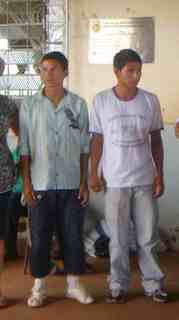
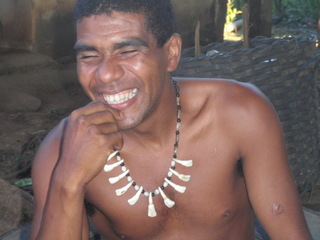
Photo: The young indigenous teachers Rolindo Vera (disappeared) and Genivaldo Vera (murdered) after their community reoccupied their traditional lands
Further information on the Guarani Kaiowá:
22/03/2010 – Report to UN reveals appalling situation of Guarani in Brazil
In Kurussu Amba, Guarani Kaiowá children and women struggle for survival
04/01/2010 – 15:29 – A Christmas story: And if the child Jesus chose to be born a Brazilian in 2009?
Categories MS
Read More says Antonio Brand. In this sense, he explains, national borders represent a problem for the Guarani because "they hinder this communication". Independent of the territorial division, they "follow their own notions and concepts of frontier, an idea more sociological and ideological, which includes, excludes and defines who belongs and who does not belong to a given collectivity."
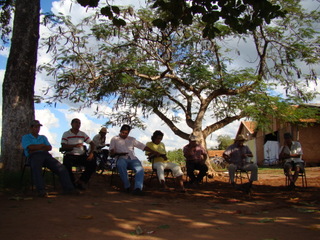 They distribute themselves in small nuclei, consisting of one or more family groups, under the leadership of the ñanderu or tekoaruvicha, leaders of a distinctly religious character, whose power was supported by the prestige due to kinship, ability to persuade and their generosity and not by force or physical ability.
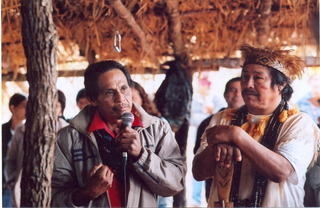 But beyond the consequences for the indigenous economy, this process of confinement has created problems for their social organization. As stated above, scattered in small, autonomous macro-familial nuclei, under the authority of elders, ñanderu or tekoaruvicha. When the situation in a given space, for various reasons, becomes inadequate, they seek out other places within this large territory. New villages are formed. The process of confinement forced these nuclei to seek shelter in reserves demarcated by the SPI, which, to manage these "gatherings" of Indians and villages, created the figure of the ‘captains’, indigenous leaders more familiar with the Western way of life, arbitrarily nominated as top leaders in the reserves. And to help them to exercise power and maintain order, over those who had no power, the Indian police were also established. Insofar as the traditional indigenous territory was being occupied by various fronts of exploration, the macro-familial groups were being forced to move into stocks and thus, in addition to live and play lots increasingly smaller groups with other macro family had to submit to the authority of foreign leaders.
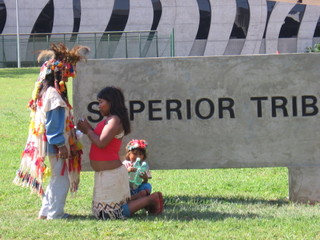 From the late 1970s, the Guarani begin to find support in their demand for land by sectors of the Church, through the Indigenous Missionary Council – CIMI, and by civil society through NGOs There is, in the region from 1980, an ambivalent motion. At the same time in which there occurred a
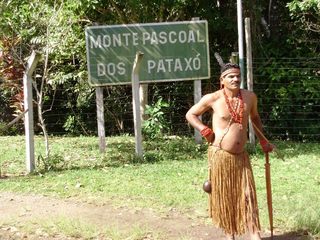
 The brothers and sister are the leaders of the community of the Serra do Padeiro, of the indigenous Tupinambá people, in the South of the state of Bahia, Brazil. The leaders have returned to their community. They will have to remain at the disposition of the authorities during the investigations of the allegations.
  Struggle for land
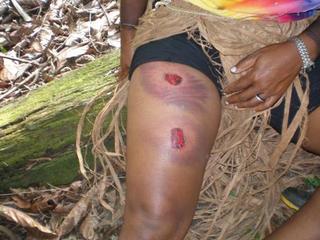 History of police aggression