
Organizações articulam oposição unificada a hidrelétricas na Amazônia
De
O evento ocorre no Parque de Exposição de Itaituba, e contará com a presença de pesquisadores do Painel de Especialistas que avaliou os impactos da usina de Belo Monte, do Ministério Público Federal e de várias organizações socioambientais.
O encontro é organizado pelo Movimento Xingu Vivo para Sempre; Movimento Tapajós Vivo; Movimento em Defesa do Rio Teles Pires; Movimento
Sobre os projetos
Rio Madeira – Serão apresentados e discutidos os problemas que já ocorrem nas obras das usinas de Santo Antonio e Jirau, como superpopulação da região de Porto Velho, desmatamentos, mortalidade de peixes, epidemias de dengue, altíssimos índices de prostituição, aumento da violência, ameaça a índios isolados, abandono das populações atingidas, gravíssimos problemas de exploração dos trabalhadores, com dois casos de trabalho escravo nas obras das duas usinas, entre outros.
Teles Pires – O governo já anunciou que fará o leilão de comercialização da energia da primeira das cinco hidrelétricas mapeadas e em processo de licenciamento no rio, a Hidrelétrica de Teles Pires, localizada entre os municípios de Paranaíta (MT) e Jacareacanga (PA). De acordo com o procurador de Justiça Luiz Alberto Esteves Scaloppe, titular da Procuradoria Especializada
Tapajós – O Complexo Tapajós deverá ter cinco usinas hidrelétricas, São Luiz de Tapajós, Jatobá, Cachoeira dos Patos, Jamanxim e Cachoeira do Caí, que afetarão diretamente 871 km² de áreas protegidas de floresta (Parque Nacional da Amazônia, que será inundado em
Rio Xingu – Os complexos processos de licenciamento e leilão da usina de Belo Monte foram marcados por uma série de ilegalidades que perpassam da inconstitucionalidade (a não consulta, prevista por lei, às populações indígenas) à falta de garantias ambientais expressas pelo próprio Ibama. O projeto de Belo Monte ainda é alvo de 15 questionamentos judiciais sobre a viabilidade econômica da obra e os impactos sociais e ambientais na região. Devido às grandes mudanças sazonais do rio, a usina só produziria 39% da sua capacidade, pouco menos de 4200 megawatt dos 11 mil prometidos, o que a torna inviável do ponto de vista econômico. Na Volta Gran de do Xingu, onde está sendo planejada a usina,
Serviço:
O que: I Encontro dos Povos e Comunidades Atingidas por Projetos de Infra-Estruturas nas Bacias dos Rios da Amazônia: Madeira, Tapajós, Teles Pires e Xingu
Quando:
Onde: Parque de Exposição de Itaituba, Itaituba, PA
Mais informações:
Antonia Melo (Movimento Xingu Vivo para Sempre) – (93) 9135-1505
Iremar Ferreira (Movimento
Nilfo Wandscheer (Movimento em Defesa do Rio Teles Pires) – (65) 9995-7668
Padre Edilberto Sena (Movimento Tapajós Vivo) – (93) 9122-6398
Assesoria de Comunicação: Verena Glass – (11) 9853-9950
Categories PA
Read More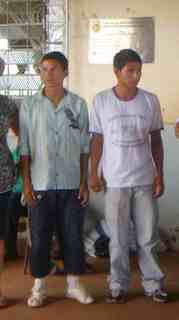 It has been nearly three hundred days since the brutal murder of the indigenous teachers, Genivaldo and Rolindo Vera of the Guarani Ñandewa people, in southern Mato Grosso do Sul on the border with Paraguay. The facts were reported nationally and internationally. The body of Genivaldo was found in the Ypo’i
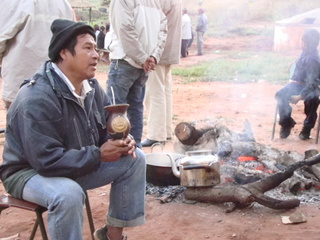 says Antonio Brand. In this sense, he explains, national borders represent a problem for the Guarani because "they hinder this communication". Independent of the territorial division, they "follow their own notions and concepts of frontier, an idea more sociological and ideological, which includes, excludes and defines who belongs and who does not belong to a given collectivity."
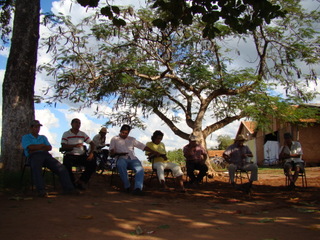 They distribute themselves in small nuclei, consisting of one or more family groups, under the leadership of the ñanderu or tekoaruvicha, leaders of a distinctly religious character, whose power was supported by the prestige due to kinship, ability to persuade and their generosity and not by force or physical ability.
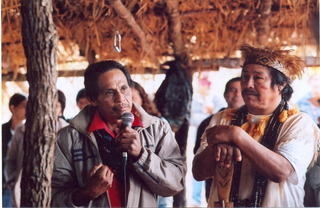 But beyond the consequences for the indigenous economy, this process of confinement has created problems for their social organization. As stated above, scattered in small, autonomous macro-familial nuclei, under the authority of elders, ñanderu or tekoaruvicha. When the situation in a given space, for various reasons, becomes inadequate, they seek out other places within this large territory. New villages are formed. The process of confinement forced these nuclei to seek shelter in reserves demarcated by the SPI, which, to manage these "gatherings" of Indians and villages, created the figure of the ‘captains’, indigenous leaders more familiar with the Western way of life, arbitrarily nominated as top leaders in the reserves. And to help them to exercise power and maintain order, over those who had no power, the Indian police were also established. Insofar as the traditional indigenous territory was being occupied by various fronts of exploration, the macro-familial groups were being forced to move into stocks and thus, in addition to live and play lots increasingly smaller groups with other macro family had to submit to the authority of foreign leaders.
 From the late 1970s, the Guarani begin to find support in their demand for land by sectors of the Church, through the Indigenous Missionary Council – CIMI, and by civil society through NGOs There is, in the region from 1980, an ambivalent motion. At the same time in which there occurred a
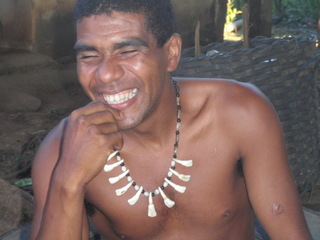 The brothers and sister are the leaders of the community of the Serra do Padeiro, of the indigenous Tupinambá people, in the South of the state of Bahia, Brazil. The leaders have returned to their community. They will have to remain at the disposition of the authorities during the investigations of the allegations.
 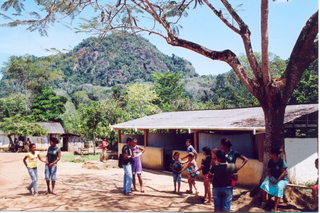 Struggle for land
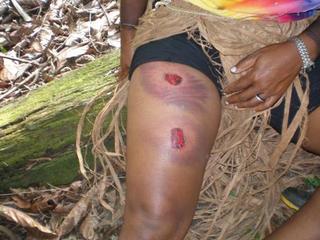 History of police aggression