 [1]
[1]
Approved by Congress in late 2023, the year of 2024 was the first fully under the Law 14.701/2023 in Brazil. Expectations amongst Indigenous Peoples and their allies were for the swift dismissal of the Law, given its flagrant conflict with the ruling of the Supreme Court on the so-called Temporal Frame theme, and its disruption with the Constitution itself. It wasn’t, however, what happened. The Law stayed valid throughout the year, rendering vulnerable territorial rights of Indigenous Peoples, causing insecurities and fueling conflicts and attacks against Indigenous communities in all regions of the country. That is the picture shown on the yearly Report on Violence Against Indigenous Peoples in Brazil – data from 2024, edited by the Indigenist Missionary Council (Cimi).
The Brazilian Executive branch is responsible for demarcating Indigenous Lands and it has pointed the Law as a major obstacle preventing advancement in administrative recognition processes for regularizing Indigenous Lands. In spite of the immediate complaints against the Law, the Supreme Court opted to keep it in order and established a conciliation procedure, reopening issues once closed.
As a consequence, demarcation processes advanced only slowly, and previously demarcated Indigenous Lands registered a number of invasions by land grabbers, farmers, hunters, loggers, and illegal miners, who felt the context of rights dismantling as an incentive to their practices. Numbers for assassinations and suicides amongst Indigenous Peoples remained high, as well as lack of assistance and state omission.
Climate crisis aggravated the outlook, with unprecedented floods in the state of Rio Grande do Sul, and severe droughts followed by big wild fires in the Pantanal, Cerrado and the Amazon biomes. Indigenous Peoples were among the most severely affected by such catastrophes. In Southern Brazil, the floods worsened the condition of already vulnerable communities without access to land, and in roadside camps. In the North, and Center-East, lack of structure and state personnel to monitor and protect Indigenous Lands affected the capability to fight the forest fires, which consumed the vegetation in several territories.
In face of little hope in the advancing demarcations, some Indigenous communities tried to guarantee a modicum of areas to survive in their own territory by occupying and reclaiming lands. Retaliation came through a series of violent attacks
The previous year, 2023, ended with a series of attacks against the Avá-Guarani in the state of Paraná and the passing of the Law that deconstructed constitutional rights. 2024 already began with a brutal attack that set the pace for what the year would turn out to be.
On January 21st, a group of armed farmers fired upon reclaimed territories of the Pataxó Hã-hã-hãe and Pataxó people in Potiguará, a municipality in Southern Bahia. Indigenous leader Maria Fátima Muniz de Andrade, also known as Nega Pataxó Hã-Hã-Hãe, was shot and murdered, three others were shot, and several others were left injured during the attack.
The Avá-Guarani people of the state of Paraná was constantly victimized in 2024, as well as the Guarani Kaiowá of Mato Grosso do Sul, especially from July to September. In face of little hope in the advancing demarcations, some Indigenous communities tried to guarantee a modicum of areas to survive in their own territory by occupying and reclaiming lands. Retaliation came through a series of violent attacks from farmers and sicarios – all with participation or support from local police forces.
The cases registered in this chapter hold intimate ties with the dismantling of Indigenous rights caused by Law 14.701/2023, something that is recognized by the State’s own Agency for Indigenous Peoples’ issues (Funai)

“No to the temporal frame”: sign on Indigenous Land Panambi – Lagoa Rica, in Douradina (MS), that was continuously under attack during 2024. Image: Gabriel Schlickmann
Violence Against Indigenous Heritage
The first chapter of the Report gathers a total record of 1,241 cases of violence against Indigenous Peoples’ territories in 2024. The section is divided into three categories: omission and delays in the recognition of Indigenous Lands, with a list of all Indigenous Lands with pending procedures for regularization, with 857 cases; territorial rights-related conflicts, with a total record of 154 cases in 119 Indigenous lands of 19 states; and illegal exploitation of natural resources and miscellaneous damage to property, with 230 cases recorded in 159 Indigenous Lands in 21 Brazilian states.
The cases registered in this chapter hold intimate ties with the dismantling of Indigenous rights caused by Law 14.701/2023, something that is recognized by the State’s own Agency for Indigenous Peoples’ issues (Funai). Cimi called upon the Agency to comment on the issue , through the Brazilian Law for the Access of Information (LAI), to which the institution admits that the measure could potentially affect ‘all Indigenous Lands still in administrative recognition phase before final regularization’.
The thesis of the temporal frame contained in the Law restricts demarcation to only those territories which were occupied in October 5th, 1988 – the day of the promulgation of the Brazilian Federal Constitution. The fundamental consequence is that those Indigenous Groups who were forced out of their territories could be made unable to claim them back.
Besides the application of the temporal frame, the Law also predicts significant changes in the administrative recognition procedures. Some of such changes would be hard to fulfill and are already, according to Funai itself, resulting in an ‘increase in delays of demarcation processes’. Other stated changes are not entirely clear, and could even be ‘unrealistic’ and ‘undoable’.
Listed impacts on Indigenous Heritage in the Report include the 857 Indigenous Territories with pendencies to be fully recognized; 555 of those haven’t had any State action toward recognition yet. Shy advances were seen in 2024: five Indigenous Lands were homologated by the President; eleven were declared by the Ministry of Justice, and sixteen Technical Groups were formed to perform Identification studies of new Indigenous Lands by Funai. These numbers are not enough to change the overall picture. Even if the current government shows better marks than its predecessor, to date, Lula’s current term in office is his slowest in demarcating Indigenous Lands, with lower averages than its time from 2003 to 2010.
As an effect, approximately two thirds (78) of the Indigenous Lands and Territories that recorded territorial conflicts in 2024 are not yet fully recognized. Those areas concentrate 101 from the 154 recorded cases by Cimi in 2024.
For invasions, illegal exploitation of natural resources and diverse damage to indigenous heritages, the majority of the recorded cases happened in recognized Indigenous Lands (85), Reservations (10), or Indigenous privately owned lands (2). At least 48 Indigenous Lands recorded cases of forest fires in 2024, with large areas being entirely consumed by the fire.
Disintrusion State’s actions were taken in some Indigenous Lands and represented a stark contrast between the current government of Luiz Inácio Lula da Silva, and his predecessor Jair Bolsonaro, whose permissive attitude and anti demarcation narratives incentivized massive invasions in Indigenous Lands. The data and reports regarding such actions, however, indicate that the areas prioritized by the government are still not free from invaders. That is the case of the Indigenous Lands Apyterewa, in the state of Pará, Karipuna, in Rondônia, and Yanomami, between the states of Amazonas and Roraima, among others.
In the state of Mato Grosso, the Indigenous Land Sararé, of the Nambikwara people, recorded an unprecedented increase in devastation caused by illegal gold mining. The existence of illegal mining has been reported by the Indigenous group since 2017, but drastically increased in 2024. In the state of Maranhão, several cases of pressure over territories were reported from agribusiness, land grabbers and loggers.
Armed attacks on Indigenous Communities requiring land recognition were grave and numerous, and had many implications recorded on different categories in this section

Free Land Camp 2024, in Brasilia Federal District: Pataxó Indigenous People reminds Nega Pataxó Hã-hã-hãe, murdered in January 2024 by armed farmers. Image: Tiago Miotto/Cimi
Violence against the Person
The second chapter recollects the total 424 cases of Violence Against Individuals recorded in 2024. The section is divided into nine categories: abuse of power (19 cases); death threats (20); various threats (35); murders (211); manslaughter (20); bodily injury (29); racism and ethnic-cultural discrimination (39); attempted murder (31); and sexual violence (20).
The three states that recorded the highest rates of assassination have maintained constant in the last years. In 2024, Roraima (57), Amazonas, and Mato Grosso do Sul (33) had the higher numbers, with Bahia – where there were 23 murders, also recording rising rates.
The record, a total of 211 recorded assassinations, were compiled from data basis from the Sistema de Informação sobre Mortalidade (SIM) – System of Information on Mortality; state-level health secretariats, and information obtained from the Indigenous Healthcare Agency Secretaria Especial de Atenção à Saúde Indígena (Sesai) via LAI.
Armed attacks on Indigenous Communities requiring land recognition were grave and numerous, and had many implications recorded on different categories in this section. The Murders of Nega Pataxó Hã-Hã-Hãe and Neri Ramos da Silva, killed during a police operation in the Ñande Ru Marangatu Indigenous Land, stand out for the brutality and participation of security forces.
Besides the terror they have to live with, the constant threats, the injuries and gunshots of the several attacks on communities such those recorded in Tekoha Guasu Guavirá, in the state of Paraná, and Panambi – Lagoa Rica, in Mato Grosso do Sul, many Indigenous persons reported cases of racism faced when in hospitals to seek for health care, a situation of inhuman discrimination.
Over 30 attacks were reported on Indigenous Communities throughout Brazil. At least ten people still have bullets lodged in their bodies: nine Avá-Guarani and one Guarani Kaiowá, the latest with a projectile in the head.
Many of the cases reported are recurrent issues and refer to the general lack of education and healthcare structure in Indigenous villages throughout the country, as well as the lack of basic sanitation and access to drinking water

Free Land Camp 2024, in Brasilia, Federal District. Image: Hellen Loures/Cimi
Violence by Omission from the State
Cases of violence by the omission from the state are organized in seven sections in the Report’s third chapter. According to data collected from SIM, state-level secretariats and Sesai, there were 208 suicide cases were reported among Indigenous Peoples in 2024. Like the previous year, the states of Amazonas (75), Mato Grosso do Sul (42) and Roraima (26) registered the highest numbers. Among Indigenous Peoples, suicide cases concentrate mainly in people up to 19 years old (32%), and between 20 and 29 years old (37%).
Data from the same sources also showed a record of 922 deaths of children between 0 and 4 years of age, with the highest concentration of cases in the state of Amazonas (274 deaths), Roraima (139), and Mato Grosso (127). Again, the majority of such cases was caused by causes considered avoidable, amongst which stand out deaths caused the flu and pneumonia (103); diarrhea, gastroenteritis and other infectious intestinal diseases (64); and malnutrition (43). Adequate healthcare measures, vaccination, diagnosis and proper treatment could have avoided or considerably diminished the lethal outcome in these cases.
The Report also contains the following data for the section: general lack of assistance (47 cases); lack of assistance in Education (87); lack of assistance in Health care (83 cases); dissemination of alcoholic beverages and other drugs (10); and death for lack of health care (84 cases). A total of 311 cases.
Many of the cases reported in this chapter are recurrent issues and refer to the general lack of education and healthcare structure in Indigenous villages throughout the country, as well as the lack of basic sanitation and access to drinking water. The floods and excessive rain in the state of Rio Grande do Sul and the drought in Northern Brazil aggravated the existing circumstances and, in some cases, rendered whole communities in a severe state of vulnerability.
The lack of access to land also results in health issues, as was recorded by different Indigenous Peoples. Rivers and streams get polluted with mercury from the illegal mining of gold, and from the poisonous chemicals used in extensive monocultural farming.
The year 2024 also had reported several cases of lack of assistance towards the migrant Warao Indigenous People. In many cities, these indigenous migrants originally from Venezuela, were allocated in improvised shelters without basic living conditions. Cases as such were reported in the states of Bahia, Mato Grosso, Paraíba and Roraima.
At least 22 Indigenous Lands that contain 48 reported isolated groups have had invasions, illegal exploitation of natural resources or other territorial issues during the year

In 2024, illegal mining invasions shot up in the Indigenous Land Sararé, in the state of Mato Grosso, of the Nambikwara people. Image: Fabio Bispo/Greenpeace
Indigenous Peoples in Isolation
The fourth chapter of the Report presents the situation and the challenges faced by Indigenous Peoples in voluntary isolation. Invasions on their territories and overall lack of protection are the main risks for the groups that remain without official State recognition. According to Cimi’s special team for the matter, Equipe de Apoio aos Povos Livres (Eapil), there are at least 119 of such groups.
From those, 37 are reported to be localized in areas that are not demarcated and remain without any kind of state protection. In December, Funai issued a Restriction Order to guarantee protection on the area occupied by the isolated groups of the Mamoriá River, in the municipalities of Lábrea and Tapauá, in the state of Amazonas. In the same state, however, the isolated group that inhabit the area of the Caribi River, in the municipality of Itapiranga, remain without any kind of state protection in spite of large documentation and reports attesting to their existence in the area.
Even the groups in voluntary isolation who inhabit areas inside recognized territories have faced threats in 2024. At least 22 Indigenous Lands that contain 48 reported isolated groups have had invasions, illegal exploitation of natural resources or other territorial issues during the year.

Free Land Camp 2024, in Brasilia, Federal District. Image: Hellen Loures/Cimi
Memory
The fifth chapter reflects on Memory and Justice and brings, on this volume, a review on the advances achieved in the fight for reparation and non-repetition of violations, as well as justice to Indigenous Peoples by the creation of a National Commission of Truth in Brazil.
The text showcases the advances achieved and the challenges faced in the period after the passing of the researcher Marcelo Zelic (1963-2023), who dedicated his life to the subject, and points to the paths taken and foreseen in the struggle for the preservation of memory and the reparation of violations to the rights of Indigenous Peoples’ Human Rights.
Papers and analysis
This volume presents, beyond the chapters developed for the data, a set of analytical papers. The permanence of stereotypes and discriminatory views on Indigenous Peoples in Brazil is studied in two papers: the first analyses the difficulties faced to guarantee the respect of Indigenous Peoples’ rights in the Criminal Judicial System, the other examines cases of racism and discrimination against Indigenous individuals and collectivities in Brazil. State Indigenist policies budget during Lula’s third presidential term and the effects of Law 14.701 and the conciliation procedures in the Supreme Court on Indigenous Peoples’ Rights are the subject of two other papers. A retrospective view on the Southern floods and Climate Crisis in regarding Indigenous Peoples in the state of Rio Grande do Sul makes up one more paper. Lastly, two articles detail the reality of the territories under attack during 2024: Indigenous Lands Tekoha Guasu Guavirá, of Avá-Guarani, in Western Paraná; and Panambi – Lagoa Rica, of the Kaiowá Guarani, in Mato Grosso do Sul.
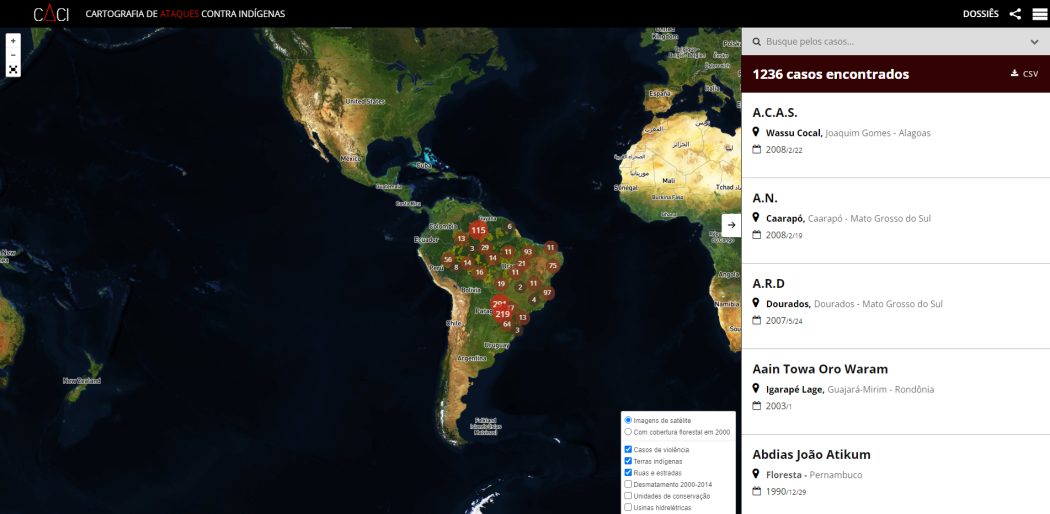
The Caci [3]plataform [3], an online map that showcases information about assassinations of Indigenous Peoples in Brazil, received a recent update with the new information from the Report. Caci stands for Cartography of the Attacks Against Indigenous (from the original in Portuguese), and also means “pain”, in Guarani. With the inclusion of the most recent data, the Platform now contains the geographical information of 1,525 assassination cases, with compiled data since 1985.
Access at caci.cimi.org.br [4]

Cover photoTekoha Yvy Ajere was one of the reclaimed land from Guarani and Kaiowá territories inside the Indigenous Land Panambi-Lagoa Rica, in Douradina (MS). It was intended to guarantee some area for the community to plant and avoid the destruction of one of the last forested areas in the region. In retaliation, farmers kept a camping site mere meters from the reclaimed site. Armed attacks, threats and intimidations were made on an everyday basis. The Indigenous People, however, resisted, determined to have their territory back. The picture was taken on July 30th, 2024, by Gabriel Sclickmann. More information at: gabrielslk.com.br [5]
Translated from Portuguese by Christian Ferreira Crevels